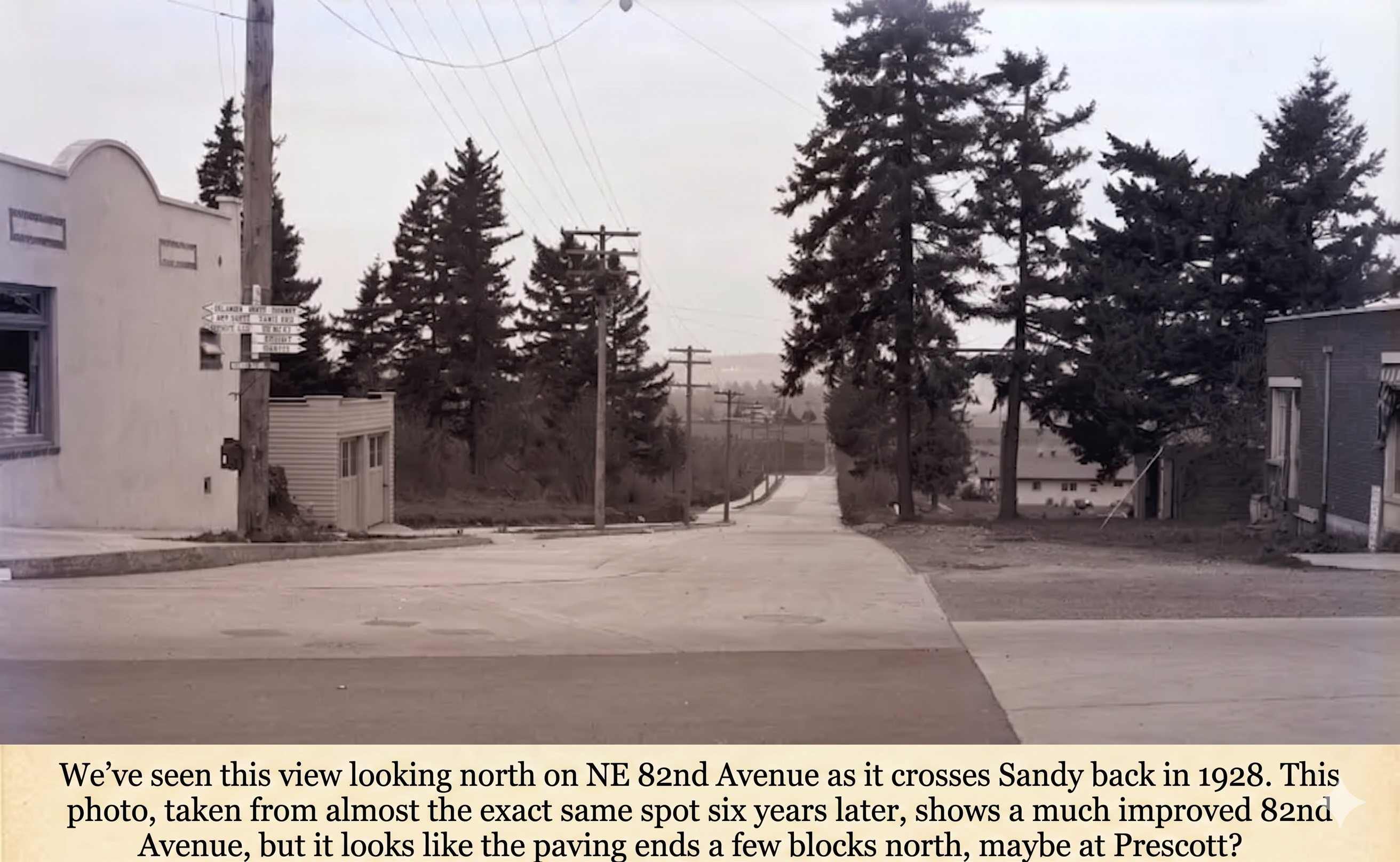
| Early 1900s | 82nd Avenue is a dirt farm-to-market road well beyond city limits. |
| 1930s | Annexation of streetcar suburbs east of the Willamette River makes 82nd Avenue the eastern edge of Portland. |
| 1932 | 82nd Avenue is designated as a state highway, bringing in federal investment. |
| 1934 | Most of 82nd Avenue is paved and widened to facilitate regional and statewide movement. |
| 1940s – 1950s | Post-war suburban development picks up in the unincorporated fields and forests east of 82nd Avenue. |
| 1960s – 1970s | As the city continues to grow, continued auto-oriented development shapes the character of 82nd Avenue. |
| 1982 | Construction of Interstate 205 is completed, creating a new bypass route that supports regional and interstate movement. |
| 1980s – 1990s | Annexation expands city limits several miles east of 82nd Avenue. The street steadily evolves into a central commercial spine for East Portland. |
| 2000s – 2021 | Various community advocacy and planning efforts push to reimagine 82nd Avenue as a multimodal city street. Calls for jurisdictional transfer begin and gain traction. |
| 2022 | PBOT takes ownership of 82nd Avenue, and $182 million is committed to improvements along the corridor. |